Introduction
4MLinux is a versatile and lightweight Linux distribution designed with multiple use cases in mind. Although it occupies minimal system resources, it offers a rich feature set that spans from system rescue and multimedia playback to server functionalities and a compact desktop environment. In this extensive article, we will explore what 4MLinux is, how it works under the hood, its primary orientations, and several interesting curiosities that make it stand out.
What is 4MLinux?
Overview
4MLinux is a small, independent Linux distribution developed by Paweł Pijanowski and his team. The name “4M” refers to its four main components or “M’s”: Maintenance, Multimedia, Miniserver, and Mystery. Together, these four pillars represent the core functionalities that the distribution emphasizes.
History and Development
The first public release of 4MLinux appeared in early 2010. Over the years, it has gone through numerous updates, gradually incorporating new features while retaining the original focus on minimalism and efficiency. The development team follows a rolling-release model for certain components, ensuring that the system remains up-to-date without requiring complete reinstallation.
- Initial Release: 2010
- Current Stable Version: 40.0 (as of mid-2024)
- Release Model: Scheduled releases roughly every three months
- Package Updates: Rolling updates for selected core packages
Philosophy
The guiding principle behind 4MLinux is simplicity combined with versatility. By keeping the base system lean, it allows users to run the OS on older hardware while still benefiting from modern Linux capabilities. The distribution’s modular approach enables users to install only what they need, from media codecs to server daemons.
How it Works
Core System Components
At its heart, 4MLinux uses the Linux kernel (version 5.x series) and the GNU C Library (glibc). A minimal system initialization is provided by SysVinit scripts instead of systemd, contributing to its fast boot times and predictable behavior.
- Init system: SysVinit
- Shell: Bash
- Core Utilities: GNU Coreutils, util-linux
- Compiler: GCC and Clang
- Libraries: glibc, libstdc
Package Management
4MLinux employs a custom package manager named JFS (Journaling File System) manager for handling most software installations. It can also use RPM packages converted via rpm2lpkg. This hybrid approach allows flexibility while maintaining simplicity.
Key Features of the Package System
- Simple package format (.lzm, .bz2)
- Dependency resolution via custom scripts
- Ability to convert and use RPM packages
- Support for binary and source-based installations
Desktop Environment and User Interface
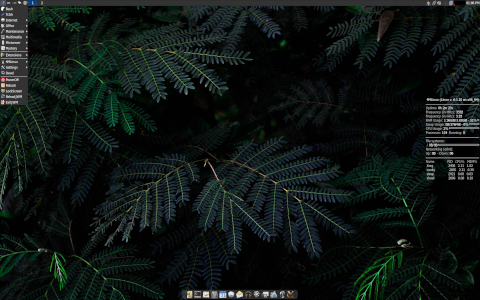
By default, 4MLinux provides the JWM (Joe’s Window Manager) for a lightweight graphical interface. This window manager is known for its speed and low memory footprint. Additionally, users can install Openbox or IceWM if they prefer alternative minimalist environments.
- Default DE: JWM
- Alternative WMs: Openbox, IceWM
- Graphical Tools: Floppy-based package installer, Firefox, AbiWord
Target Audience and Use Cases
4MLinux is oriented toward four main uses, each represented by one of the “M’s.” Below we describe each orientation and typical scenarios where 4MLinux excels.
1. Maintenance (System Rescue)
4MLinux Rescue Edition serves as a live CD/USB environment for system repair. Technicians and home users can boot into a functioning Linux system to perform tasks such as:
- Partition management (GParted)
- Password recovery (chntpw for Windows passwords)
- File system checks and repairs
- Data backup and recovery
2. Multimedia
When used as a multimedia station, 4MLinux comes preloaded with audio and video players, codecs, and a mini-DVD recorder interface. Key applications include:
- VLC for video playback
- Audacious for audio
- Brasero or growisofs for optical media
- Graphics viewers and editors such as mtPaint
3. Miniserver
4MLinux can act as a lightweight server, providing essential network services. It includes daemons for:
- Apache HTTP Server
- FTP (vsftpd)
- SSH (Dropbear)
- DHCP and DNS via dnsmasq
- Mail server functionality using Postfix
4. Mystery (Mini Desktop)
Under the “Mystery” banner, 4MLinux functions as a minimal desktop suited for basic tasks like web browsing, email, and document editing. Typical applications include:
- Web browser: Firefox ESR
- Email client: Claws Mail
- Office suite components: AbiWord, Gnumeric
- Terminal emulator: xterm, URxvt
Installation and Requirements
Hardware Requirements
4MLinux’s minimal footprint allows it to run on older machines or systems with limited resources:
- CPU: Pentium 4 / AMD Athlon 64 or newer
- RAM: 128 MB (256 MB recommended for GUI)
- Disk Space: 1 GB for base installation
- Graphics: Any VESA-compatible graphics card
Installation Steps
The installation procedure is straightforward, whether you choose the live mode or a full hard drive installation.
1. Booting from Media
- Create a bootable CD/USB using dd or a tool like Rufus.
- Boot the target machine and select the 4MLinux boot option.
- Choose live or install mode from the menu.
2. Installation Wizard
- The built-in installer guides you through partitioning and package selection.
- Configure network settings, locale, and user accounts.
- Finalize installation reboot into your new 4MLinux system.
Features and Applications
| Category | Application / Feature | Description |
|---|---|---|
| Rescue Tools | GParted, TestDisk, chntpw | Partition editing, file recovery, Windows password reset |
| Multimedia | VLC, Audacious, Brasero | Audio/video playback, CD/DVD burning |
| Server | Apache, vsftpd, Dropbear | HTTP, FTP, SSH services |
| Desktop | JWM, Firefox, AbiWord | Lightweight window manager, web browsing, word processing |
| Utilities | Bash, Cron, SysVinit | Shell scripting, scheduled tasks, system initialization |
Curiosities
- Small ISO Size: The full ISO is under 200 MB, making it easy to download and transfer.
- Snap amp Flatpak: Though minimal, 4MLinux supports Snap and Flatpak installations for additional apps.
- Portable Mode: It can run entirely in RAM for live sessions, allowing you to remove the boot media after startup.
- Custom Scripts: Many recovery tools are wrapped in custom scripts to simplify usage for less experienced users.
- Translation Efforts: The project’s website and documentation have been translated into over 30 languages by community volunteers.
Conclusion
With its four pillars—Maintenance, Multimedia, Miniserver, and Mystery—4MLinux delivers a comprehensive yet lightweight solution for diverse tasks. Whether you need a rescue environment, a multimedia station, a basic server, or a compact desktop, 4MLinux provides the tools and flexibility to get the job done on minimal hardware.
Leave a Reply